
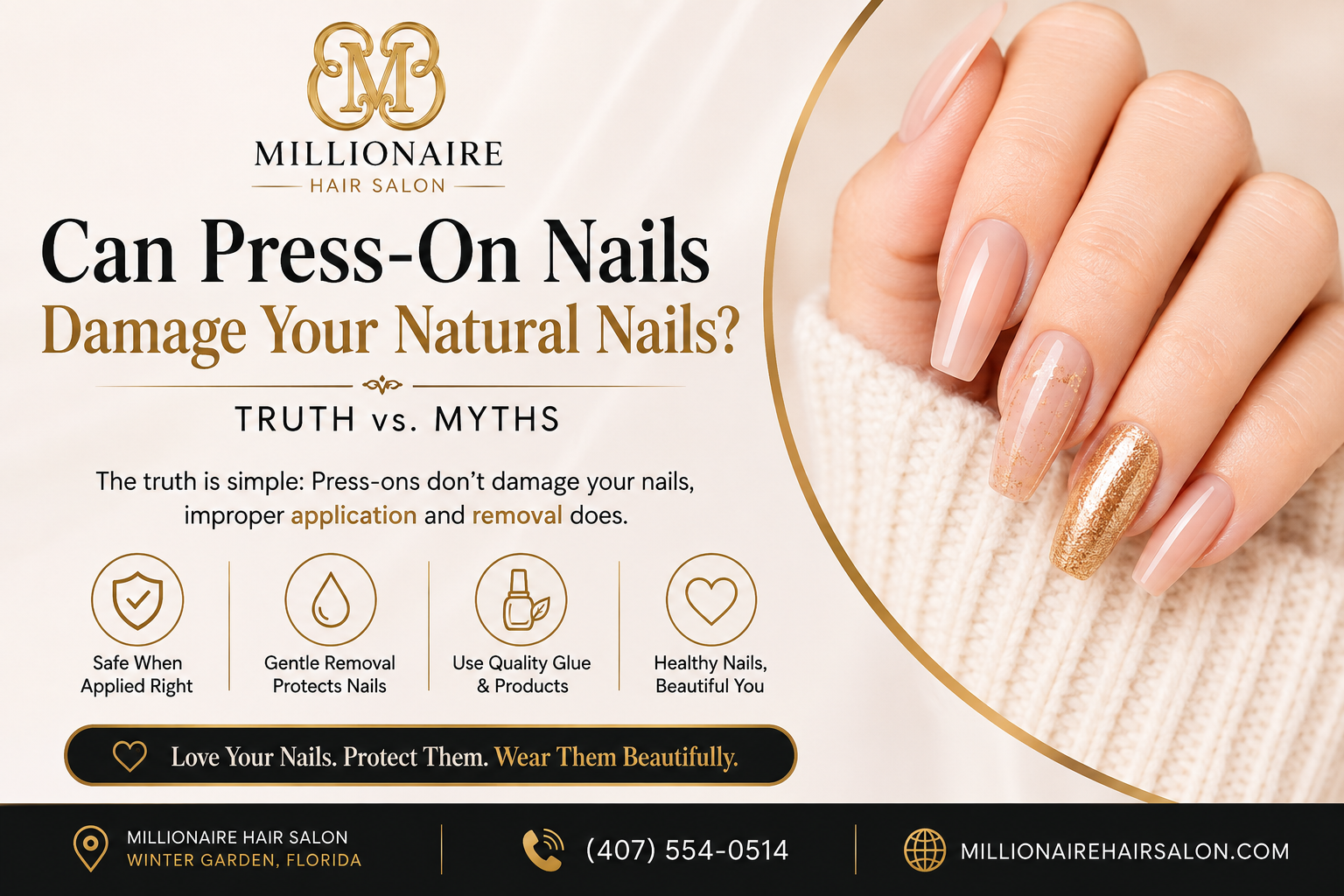
Press-on nails have gone from a quick, temporary fix to a genuine beauty staple, but the debate around whether they damage natural nails has followed them the entire way.
As nail professionals, we hear this question constantly, and the honest answer is more nuanced than a simple yes or no.
Here is what actually determines whether press-on nails harm your natural nails, separated clearly from the myths that keep circulating.
Myth: Press-On Nails Themselves Damage Your Nails
The truth is that press-on nails, on their own, do not inherently damage your natural nails. The overwhelming consensus among nail professionals is that damage results almost entirely from how the press-ons are applied and, more importantly, how they are removed, not from wearing them.
Nails are made of keratin and do not need to “breathe” the way skin does, so simply covering them with a press-on set for a period of time is not the underlying issue that causes brittleness or thinning.
What Actually Causes Damage?
Understanding the real causes of press-on nail damage helps you avoid them entirely. The most common culprit is aggressive removal, specifically peeling or prying press-ons off rather than soaking and gently lifting them, which strips away the top layers of the natural nail plate and leaves it thin, rough, or prone to breaking.
Low-quality or excessive glue is another significant factor, since cheap adhesives can dry out the nail bed and, when layered on repeatedly, weaken the nail plate over time.
Gaps between the natural nail and the press-on, caused by improper application, can also trap water and dirt, creating conditions where fungus or bacteria can develop.
| Real Cause of Damage | Why It Happens | How to Prevent It |
| Peeling or prying off press-ons | Strips layers of the natural nail plate | Always soak and gently lift, never force removal |
| Over-buffing before application | Thins the natural nail, making it more vulnerable | Lightly smooth the surface only, do not buff aggressively |
| Low-quality or excessive glue | Dries out and weakens the nail bed over repeated use | Use a gentle, nourishing adhesive and avoid layering excess glue |
| Gaps between nail and press-on | Traps moisture and bacteria, risking fungal issues | Ensure a precise, well-fitted size for each nail |
The Right Way to Apply Press-On Nails
• Lightly smooth, rather than aggressively buff, the surface of your natural nail
• Apply a protective base coat before adding adhesive, when using glue-on styles
• Measure each nail carefully against a sizing chart to avoid gaps or pinching
• File the sides gently if a press-on is slightly too wide for a custom, secure fit
• Avoid water contact for the first one to two hours after application to allow full adhesion
Precise sizing matters more than most people realize. A press-on that is too small will pinch and stress the natural nail edge, while one that is too large is more likely to lift, snag, and eventually be pulled off forcefully, which is where most of the real damage occurs.
When in doubt, choosing a slightly larger size and gently filing it down for a custom fit tends to produce the safest, most secure result.
The Right Way to Remove Press-On Nails
Removal technique matters just as much as application, and it is where the vast majority of nail damage actually happens. If glue stickers were used, soaking nails in warm water helps loosen the adhesive gently.
For solid glue or UV glue tabs, applying nail polish remover along the edges for a short period softens the bond without force. Once the press-on begins to lift naturally, it can be gently guided off rather than yanked, protecting the top layers of your natural nail plate in the process.
• Soak nails in warm water to loosen glue stickers before attempting removal
• Apply nail polish remover along the edges for solid glue or UV glue tabs
• Wait for the press-on to lift naturally rather than forcing or peeling it off
• Massage cuticle oil or a nourishing nail serum into nails immediately after removal
• Give natural nails a short rest period between sets to recover fully
Signs You Are Using Press-Ons the Healthy Way
If your natural nails remain smooth, flexible, and free of noticeable thinning or peeling after removing a set of press-ons, that is a strong sign your application and removal technique is protecting your nail health.
Conversely, if you notice increasing brittleness, visible thinning, or peeling layers after repeated use, it is worth reassessing your glue quality, your buffing habits, or your removal method, since these are almost always the real source of the issue rather than the press-ons themselves.
Can Press-Ons Actually Protect Your Natural Nails?
When applied and removed correctly, press-on nails can function as a protective barrier over your natural nails, shielding them from the everyday wear and tear of typing, cleaning, and general use.
This is particularly true for clients who struggle with nail breakage from daily activities, since a well-fitted press-on set covers and protects the natural nail underneath for the duration it is worn.
When to Give Your Nails a Rest
Even when press-ons are applied and removed correctly, taking occasional breaks between sets allows your natural nails a chance to fully recover, especially if you wear them frequently.
Using cuticle oil daily and incorporating a strengthening treatment during these rest periods helps maintain healthy, resilient nails whether you are wearing press-ons, a professional gel set, or going bare.
Press-On Nails Compared to Acrylics and Gel
Understanding how press-on nails compare to more traditional salon options helps put the damage question into broader context.
Acrylics involve a liquid and powder polymer applied and shaped directly onto the natural nail, and removal requires soaking in acetone or careful filing, both of which can weaken the nail plate if not performed correctly by an experienced technician.
Gel manicures cure under UV or LED light and generally require soaking off in acetone as well, with similar risks if peeled rather than properly removed.
Press-on nails, by contrast, are designed for a shorter wear cycle and, when using quality adhesive and gentle removal methods, typically involve less aggressive chemical exposure and less filing of the natural nail than either acrylics or a full gel set.
| Nail Enhancement | Typical Wear Time | Removal Method |
| Press-on nails | 1 to 2 weeks | Soak or gentle adhesive dissolving, no acetone soak required for most types |
| Gel polish or gel extensions | 2 to 3 weeks | Acetone soak-off, requires careful technique to avoid damage |
| Acrylic nails | 2 to 3 weeks, with fill-ins | Acetone soak or professional filing, higher risk if rushed |
This comparison is not meant to suggest one option is universally superior to the others; each has a place depending on your lifestyle, how long you want your manicure to last, and how much daily wear and tear your hands typically experience.
What it does clarify is that nail health outcomes across all three options depend far more on application quality and removal technique than on which enhancement type you choose.
Signs It Is Time to See a Nail Professional
While at-home press-on application is generally safe when done correctly, certain signs indicate it is worth consulting a nail professional rather than continuing on your own.
Persistent thinning, visible white patches, ongoing pain, or any sign of infection such as redness, swelling, or discharge around the nail bed should prompt a professional evaluation rather than continued at-home nail enhancement of any kind.
A nail technician can also assess whether your natural nails would benefit from a strengthening treatment or a break period before resuming press-ons or any other enhancement.
Choosing Quality Press-Ons and Adhesives
Not all press-on products are created equal, and quality plays a meaningful role in whether your experience is a positive one. Look for sets made from flexible, well-shaped materials that closely mimic the curve of a natural nail bed, since ill-fitting, overly rigid press-ons are more prone to lifting and premature removal, which increases the risk of damage.
When it comes to adhesive, gentler, nourishing glue formulas or adhesive tabs designed specifically for sensitive nails tend to be a safer long-term choice than industrial-strength glues marketed primarily for hold rather than nail health.
Bottom Line
Press-on nails do not inherently damage your natural nails; the real risk comes from over-buffing, low-quality glue, improper sizing, and aggressive removal.
When applied thoughtfully and removed with patience, press-ons can be one of the safest, most flexible ways to change your look without the long-term commitment of acrylics or gels.
If you would rather leave the application and removal to trained professionals, visit our nail team at Millionaire Hair Salon in Winter Garden, where every set is fitted, applied, and removed with your natural nail health as the top priority.