Choosing a haircut based on trends alone is how most bad salon experiences start. The style that looks stunning on a magazine cover or a TikTok tutorial was almost certainly cut to flatter a face shape that may be nothing like yours.
At Millionaire Hair Salon in Winter Garden and Winter Park, our stylists begin every cut with the same question: what does this particular face need? The answer determines the length, the layers, the fringe, and even the part.
This guide breaks down the science and the styling behind matching a haircut to a face shape, so your next appointment starts with a plan instead of a guess.
Why Face Shape Should Drive Your Haircut Decision?
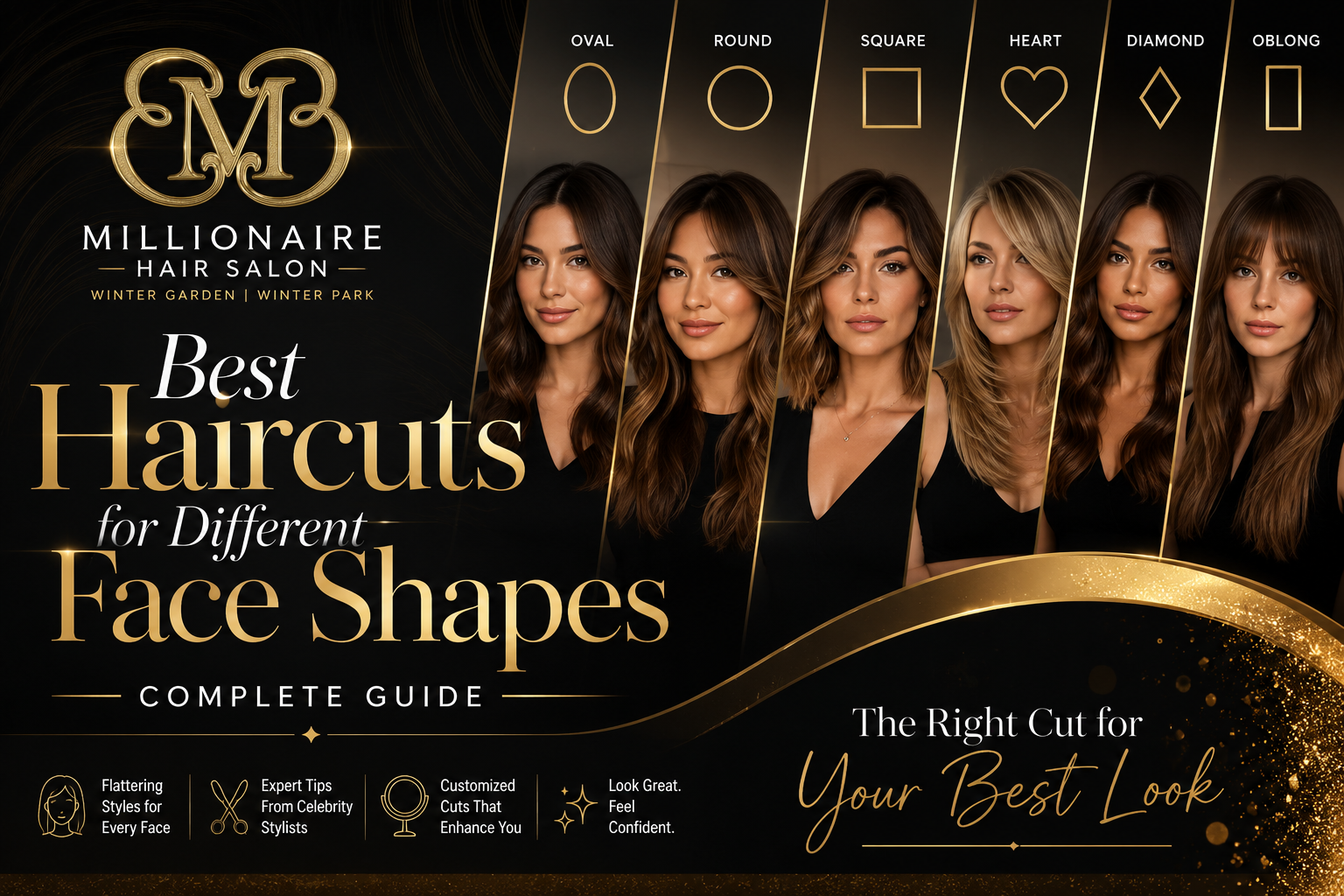
A haircut is essentially an optical illusion tool. Hair can add width where a face is narrow, create the appearance of length where a face is short, and soften angles that feel too sharp. Estheticians and stylists typically classify faces into six general categories: oval, round, square, heart, diamond, and oblong.
Identifying which category best describes your face involves comparing the width of your forehead, cheekbones, and jawline against the overall length of your face, usually by pulling your hair back and looking straight into a mirror under even lighting.
None of these categories are rigid boxes. Most people are a blend of two shapes, and a skilled stylist reads the whole picture: bone structure, hair density, hairline shape, and even how you naturally part your hair.
That is why an in-person consultation always outperforms a printed chart, but understanding the general principles below will help you have a much more productive conversation in the chair.
Oval Faces: The Most Versatile Canvas
Oval is widely considered the most balanced face shape because its proportions allow nearly any length or texture to work. Long layers add movement without disrupting the natural symmetry, while a sleek, middle-parted bob emphasizes the jawline and cheekbones beautifully.
A full, blunt fringe is also an excellent option for oval faces, framing the eyes and adding a touch of drama. Because there is little correcting to do, this is the one face shape where a client can genuinely chase a trend without worrying about proportion.
Round Faces: Creating Length and Definition
The goal for a round face is to introduce vertical lines and remove visual width at the cheeks. Long layers that start below the chin elongate the face, and a deep side part breaks up the symmetry that can otherwise emphasize roundness.
Face-framing pieces that graze the jaw draw the eye downward and outward rather than straight across the widest part of the cheek. Textured, angular layers below the chin work especially well, as does volume concentrated at the crown rather than the sides, which visually stretches the face.
• Long layers starting at or below the jaw
• Deep side parts instead of a centered part
• Face-framing pieces angled toward the chin
• Volume built at the crown, not the width of the cheeks
• A textured, longer bob rather than a rounded, jaw-length one
Square Faces: Softening Strong Angles
A square jawline is a striking feature, and the right haircut enhances it rather than fighting it. Soft, wavy layers and side-swept bangs introduce curves that balance the straight lines of the jaw and forehead.
A shag with wispy, textured ends is particularly flattering, as the broken-up pieces disrupt the geometry of the face. Sharp, blunt cuts and center parts tend to reinforce the angularity, so most stylists steer square-shaped clients toward rounded layers and asymmetry instead.
Heart Faces: Balancing a Wider Forehead
Heart-shaped faces are widest at the forehead and narrow toward the chin, sometimes with a visible widow’s peak. The objective here is to add width or softness near the jawline while minimizing bulk at the temples.
A chin-length bob or lob draws attention downward to the cheekbones and gives the illusion of a fuller jaw. Side-swept fringes are a favorite for this shape because they soften the forehead without adding the width that a full, blunt fringe would create.
Diamond Faces: Highlighting Dramatic Cheekbones
Diamond face shapes have narrow foreheads and jawlines with cheekbones as the standout feature. Styles that add width at the forehead and chin, such as soft waves or a shoulder-length cut with curtain bangs, create balance across the whole face.
Long, center-parted styles also work exceptionally well, since a sleek, straight-down silhouette echoes the natural symmetry of the shape. Heavy, blunt, straight-across bangs are typically avoided, as they can make the cheekbone area look even wider by contrast.
Oblong Faces: Adding Width, Not Length
Oblong faces share many traits with oval but are longer overall, so the priority shifts to creating width rather than length. Waves and curls add horizontal volume that shortens the visual length of the face, and a fringe, whether full or side-swept, breaks up the forehead and interrupts the vertical line running from hairline to chin.
Shoulder-length cuts with soft layers tend to outperform very long, straight styles, which can exaggerate the length even further.
Working With Your Stylist for the Best Results
Bring reference photos, but be open to adjustments. A style that flatters a similar face shape on someone else may still need tweaking based on your hair density, texture, and natural growth pattern. At Millionaire Hair Salon, every haircut consultation includes a conversation about your daily styling routine and lifestyle, because the most flattering cut on paper only works if it is realistic for you to maintain.
Our stylists, trained under celebrity stylist Jamila Burns-Sluder, combine face-shape analysis with an understanding of how hair falls and moves once you leave the chair, not just how it looks in the mirror.
Common Mistakes to Avoid When Choosing a Haircut for Your Face Shape
• Do not rely solely on a single celebrity photo without accounting for your hair’s texture and density
• Avoid choosing a cut based purely on trend without checking it against your face shape
• Be honest about your daily styling routine and time commitment before finalizing a cut
• Ask your stylist how a trending style can be adapted specifically for your proportions
• Remember that hair color, layering, and part placement all influence the final effect as much as length does
How Hair Texture Interacts With Face Shape?
Face shape is only one half of the equation; hair texture shapes how any given haircut will actually behave once it grows out and is styled day to day. Fine, straight hair tends to fall flatter and closer to the head, which can be an advantage for sleek, face-framing styles but may require additional layering to avoid looking limp around a rounder face.
Thick or coarse hair holds more volume naturally, which is often ideal for round faces needing added height at the crown, but may need more texturizing to avoid excess bulk on a square or heart-shaped face where softness is the goal. Curly and coily hair shrinks significantly as it dries, so length and layer placement must be calculated with that shrinkage in mind, especially for styles like a fringe or face-framing layers, where an inch of visual difference can change the entire effect.
Bottom Line
The right haircut is not about following a rulebook to the letter; it is about understanding the principles well enough to make an informed choice with your stylist.
Oval faces have the most freedom, round and oblong faces benefit from added length and angles, square faces soften beautifully with waves and layers, and heart and diamond shapes thrive with strategic width placement.
If you are ready to find the cut that was made for your bone structure, book a consultation at Millionaire Hair Salon in Winter Garden or Winter Park, where our award-winning team turns face-shape science into red-carpet results.