
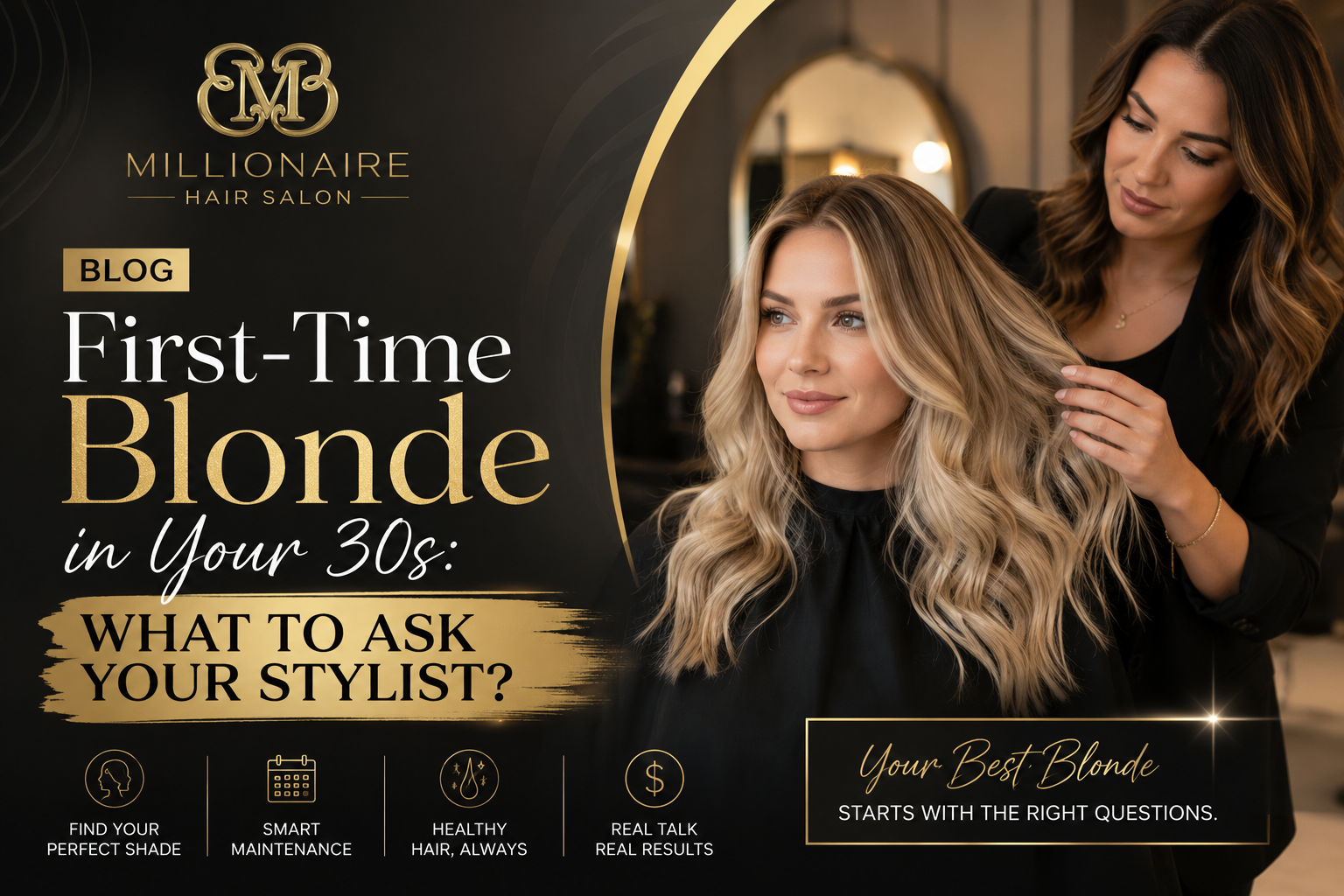
Going blonde for the first time is an entirely different experience in your thirties than it might have been at twenty. Your hair has a different history, your skin tone reads differently in cooler versus warmer light than it once did, and your lifestyle likely leaves less room for high-maintenance upkeep. None of that means blonde is off the table.
It simply means the conversation with your colorist needs to be more strategic. As a salon built around blonding and dimensional color, we walk first-time blonde clients through this exact process nearly every week, and the questions below are the ones that consistently lead to the best outcomes.
Why Going Blonde in Your 30s Requires a Different Approach?
Hair that has never been lightened behaves differently than hair with a color history, and hair in your thirties often carries more of both. Natural graying may already be starting, which changes how pigment lifts and how toner reads once applied.
Your hair may also be coarser or finer than it was a decade ago, affecting how quickly it processes. A first-time blonde transformation should never be rushed into a single sitting if your hair has significant unknowns, and an experienced colorist will tell you that upfront rather than promising a one-visit miracle.
Question 1: What Level of Blonde Actually Suits My Skin Tone?
Not all blondes are created equal, and the single biggest mistake first-timers make is choosing a shade because they liked it on someone else rather than because it complements their own undertone.
Warm skin tones generally harmonize with golden, honey, and caramel-kissed blondes, while cool undertones tend to look most natural with ash, beige, or platinum tones.
Ask your stylist to hold swatches near your face in natural light, not just under salon lighting, since fluorescent bulbs can distort how a shade will actually look once you walk outside.
• Warm undertones: honey, caramel, golden blonde
• Cool undertones: ash blonde, beige blonde, icy platinum
• Neutral undertones: nearly any blonde family, with room to experiment
• Ask to see swatches in daylight, not only under salon lighting
Question 2: How Many Sessions Will This Realistically Take?
If you currently have virgin, unprocessed hair in a medium to dark brown, moving to a noticeably lighter blonde is very likely a multi-session process.
Lightening hair too aggressively in one visit increases the risk of damage and breakage, and a responsible colorist will pace the lift over several appointments spaced weeks apart to protect the integrity of your strands.
Ask directly: “Based on my hair’s current color and condition, how many sessions do you expect this to take, and what will each one accomplish?” A vague answer here is a signal to ask more questions before committing.
Question 3: What Will This Do to the Health of My Hair?
Lightening hair lifts natural pigment out of the cortex, which can leave strands more porous and prone to dryness if not properly cared for. This is a normal part of the blonding process, not a sign that something has gone wrong, but it does mean your at-home routine needs to change.
Ask your stylist what bond-building treatments they use during the service, since these formulas work to protect the internal hair structure during lightening.
Also ask what products you should switch to at home, since regular shampoo and conditioner are rarely enough to maintain hair that has gone through a lightening service.
Question 4: How Do I Prevent Brassiness Between Appointments?
Blonde hair, especially warmer or previously colored hair, tends to pull brassy or yellow-toned as it grows out and is exposed to sun, chlorine, and hard water.
Ask your stylist which purple or blue-toned shampoo they recommend for your specific shade, and how often you should actually use it, since overuse can leave hair looking flat or overly cool-toned.
This is also a good moment to ask about heat protection, since blonde hair that has been lightened is more vulnerable to heat damage from styling tools than hair that hasn’t been processed.
Question 5: What Is the Maintenance Schedule and Real Cost Over Time?
Blonde is one of the more maintenance-intensive color categories, and it is worth understanding the full picture before your first appointment rather than being surprised later.
Ask how often you will need to return for root touch-ups, toning refreshes, and any bond-repair treatments, and get a realistic sense of the total investment over a year, not just the price of the first visit.
| Maintenance Task | Typical Frequency |
| Root touch-up | Every 5 to 8 weeks |
| Toner refresh | Every 4 to 6 weeks |
| Bond-repair treatment | Every 3 to 4 weeks or as recommended |
| Full color consultation review | Every 3 to 4 months |
Question 6: Should I Consider Foilyage or Balayage Instead of a Full Color?
For many first-time blondes in their thirties, a gradual, dimensional technique such as balayage or foliage is a gentler entry point than an all-over color.
These techniques hand-paint or foil lightener onto sections of hair, creating a softer, more natural regrowth line that requires less frequent maintenance than a single-process blonde.
Ask your colorist whether a dimensional approach might get you closer to the look you want with less commitment and less stress on your hair overall.
Question 7: What Happens If I Change My Mind?
It is worth asking your stylist directly how reversible the process is if blonde ultimately is not for you.
Because lightening removes pigment rather than adding it, going back to your natural color usually involves a semi-permanent or permanent gloss rather than simply stripping the blonde away. Understanding this before you start helps set realistic expectations for the months ahead.
Protecting Your Blonde From the Florida Sun and Pool
Living in Central Florida adds a specific consideration to blonde hair maintenance that clients in cooler climates may not need to think about as carefully: near-constant sun exposure and frequent time in chlorinated or salt water.
UV exposure can cause blonde hair to gradually shift warmer or brassier over time, while chlorine is notorious for pulling a greenish cast onto lightened hair, particularly in cooler-toned blondes.
A leave-in UV protectant spray before spending extended time outdoors, along with rinsing hair thoroughly with clean water before and after swimming, meaningfully reduces both of these risks. Clarifying treatments every few weeks also help remove mineral buildup from pool or well water that can dull blonde tones over time.
Setting a Realistic Budget for Your First Blonding Journey
First-time blonde clients are sometimes surprised by the investment required, both in the initial transformation and the ongoing maintenance that follows.
Ask your stylist for a transparent breakdown of costs for your specific hair, including the initial session or sessions, any bond-repair add-ons, and the anticipated cost of regular touch-up appointments over the following year.
Understanding this full picture before you begin allows you to plan realistically and avoid feeling caught off guard by the commitment blonde hair requires to stay looking its best.
Bottom Line
Becoming a first-time blonde in your thirties is entirely achievable, but the best results come from a conversation, not a single appointment.
Ask about your undertone, the realistic session timeline, the health of your hair, brassiness prevention, ongoing maintenance costs, and whether a dimensional technique might suit you better than an all-over color.
At Millionaire Hair Salon in Winter Garden and Winter Park, our team is led by celebrity blonde specialist and global educator Jamila Burns-Sluder, whose entire career has centered on getting first-time blonde transformations right the first time.
Book a consultation and come in with your questions ready; we will meet you with honest, personalized answers.